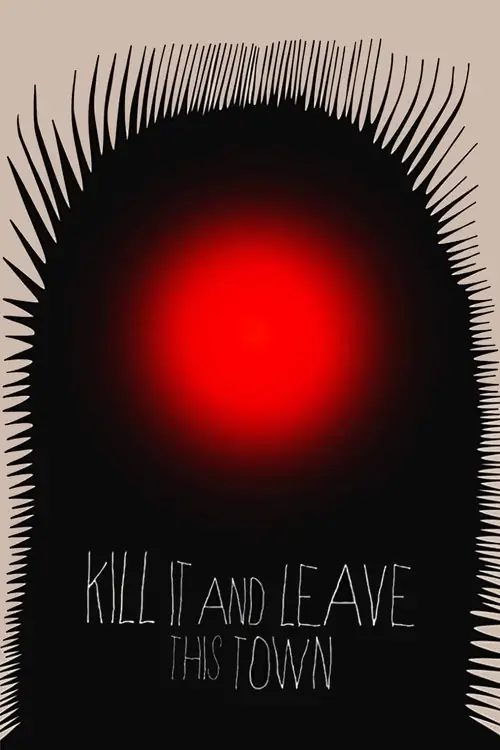
Kill It and Leave This Town
REEL ENTRY · SCI-FI · NOTES FROM TOMORROW
Grief possesses its own cartography—a private geography of loss that maps the terrain between what was and what can never be again. This animated odyssey ventures into that interior wilderness with a fearlessness that borders on the visionary. Following the devastation of losing his closest companions, the protagonist retreats into an interior realm constructed from recollection and yearning—a sanctuary where chronology has been suspended and the departed continue to exist in perpetual, unchanging presence. It is a strategy of psychological preservation that exacts a terrible cost: to inhabit this refuge is to abandon the living world entirely.
The animation style mirrors this tension between stasis and dissolution with extraordinary inventiveness. Figures and environments constantly mutate, their outlines dissolving and reforming in ways that evoke both the fluidity of remembrance and its unreliability. Colors bleed across boundaries; spaces collapse into one another without warning; characters from different temporal periods occupy the same frame, coexisting in the non-Euclidean geometry of mourning. The technique is not merely decorative but philosophically precise—it enacts, at the level of visual form, the disorienting experience of a consciousness that has withdrawn from linear time into the recursive loops of obsessive retrospection.
CUT TO · THE PAGE TURNS
Yet the film is not merely an exercise in melancholy formalism. It poses, with increasing urgency, the question of whether survival demands the destruction of one’s most cherished refuges. To re-engage with the external world requires a kind of violence against the self—a deliberate dismantling of the sanctuary one has constructed. The title’s imperative suggests both command and confession: an acknowledgment that moving forward may necessitate an act of annihilation directed inward. For those who appreciate animation as a medium capable of rendering the invisible architecture of emotional experience, this stands as a remarkable achievement—haunting, confrontational, and ultimately, in its devastating clarity, cathartic. The sound design—dissolving voices, ambient drones, the uncanny silence of spaces that should contain laughter—reinforces the visual vocabulary with an auditory dimension that makes the protagonist’s interior world palpable to anyone who has ever mourned.
Source Reference
Original archive log: https://www.themoviedb.org/movie/664594?language=en-US