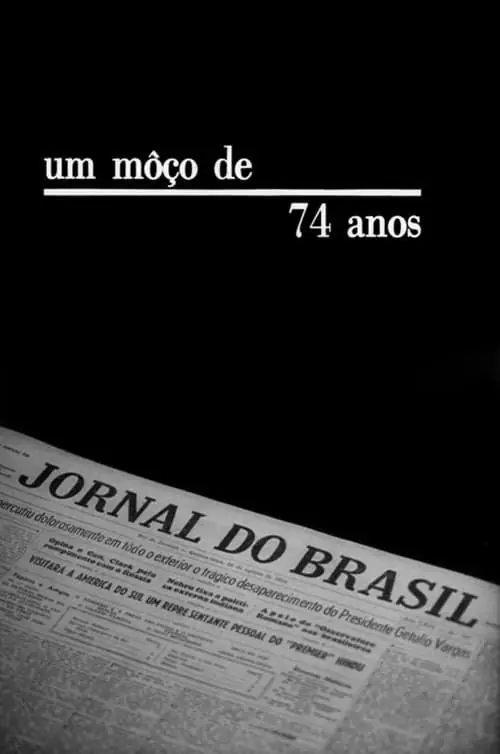
A Seventy-Four Year-Old Fellow
REEL ENTRY · SCI-FI · NOTES FROM TOMORROW
A towering achievement in non-fiction filmmaking from one of Brazilian cinema's most revered auteurs, this chronicle of a national institution of print journalism operates simultaneously as institutional portrait, political testimony, and meditation on the role of the press in societies grappling with authoritarian encroachment. The publication in question — established in the final decade of the nineteenth century — evolved from a conventional broadsheet into a radical force of journalistic innovation, its redesign in the mid-twentieth century heralding a new era of visual sophistication and editorial courage that would define the very possibilities of what a daily periodical could accomplish. The director approaches this legacy not as hagiography but as dialectic, allowing the publication's contradictions and compromises to share space with its triumphs.
The film's mid-section concentrates on the decades when the journal stood as a crucial bulwark against censorship and political repression, its reporters and editors navigating the treacherous terrain between truthful reporting and self-preservation under a military regime that regarded a free press as an existential threat. Through archival materials, oral testimonies, and the director's characteristically elegant visual compositions, we witness the daily act of putting words to paper transformed into an act of civic resistance. The editorial meetings — reconstructed and documented — reveal the agonizing calculations involved in determining what could be published and what demanded suppression for survival, the space between the lines becoming as significant as the text itself.
CUT TO · THE PAGE TURNS
The broader historical canvas against which this institutional narrative unfolds encompasses the most convulsive chapters of the nation's twentieth-century experience — democratization movements, cultural revolutions, economic upheavals — all filtered through the lens of a publication that both recorded and shaped these transformations. The director's deep affection for the craft of print journalism suffuses every frame, the tactile beauty of typesetting, layout, and distribution rendered with a lyricism that approaches the devotional. Yet the film never succumbs to nostalgia, acknowledging that even the most principled institutions are subject to the corrosive pressures of commercial viability and political expedience. As both historical record and cinematic essay, it stands as an indispensable contribution to understanding how information becomes knowledge, and knowledge becomes power.
Source Reference
Original archive log: https://www.themoviedb.org/movie/500948?language=en-US