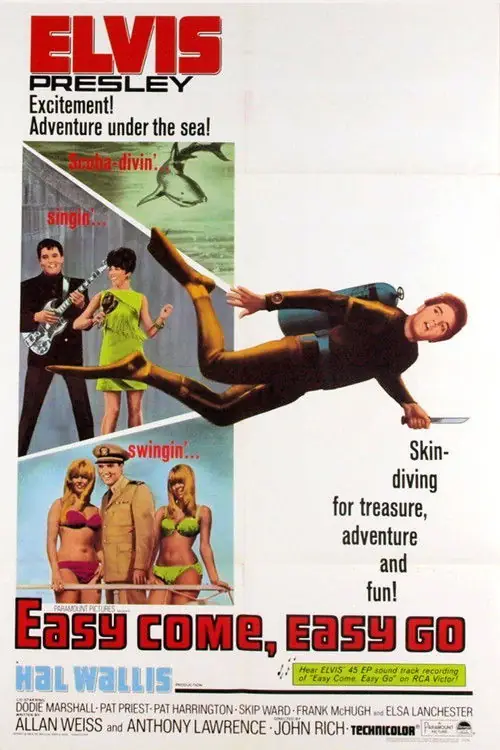
Easy Come, Easy Go
REEL ENTRY · HORROR · LATE-NIGHT ENTRY
The peculiar alchemy of the 1960s musical vehicle—that improbable genre in which a popular recording artist was deposited into a thin narrative framework designed primarily to showcase their vocal repertoire—reaches one of its more charming incarnations here. The premise grafts two complementary fantasies onto a single protagonist: by day, a naval salvage diver whose underwater expeditions yield both professional satisfaction and the occasional archaeological thrill; by night, a nightclub crooner whose easy magnetism fills intimate venues with appreciative audiences. The duality is, of course, pure wish-fulfillment—the audience receives not one but two romanticized occupations for the price of a single ticket.
The narrative proper ignites when an aquatic descent reveals the possibility of submerged treasure—a discovery that transforms routine military duty into a competitive adventure. The plotting is perfunctory in the manner characteristic of the era’s star-driven entertainments, functioning primarily as connective tissue between musical numbers and comedic set-pieces. Yet what elevates the material beyond mere contractual obligation is the leading man’s undeniable screen charisma and the production’s evident commitment to mounting each sequence with professional polish. The underwater photography, in particular, demonstrates a technical resourcefulness that belies the film’s modest ambitions, capturing the eerie beauty of the ocean floor with a clarity that makes the treasure-hunting sequences genuinely compelling.
CUT TO · THE PAGE TURNS
The musical performances, as one would expect, constitute the primary attraction—each number staged with the cheerful artificiality that defines the genre’s aesthetic. The songs may not linger in the memory with the persistence of the era’s most enduring compositions, but they serve their purpose with efficiency and occasional flair. For students of mid-century popular entertainment, the film offers a fascinating window into a mode of filmmaking that has entirely vanished—a world where star persona was considered sufficient dramatic architecture, and where the audience’s desire to simply spend time in a performer’s company was understood as the most reliable draw at the box office.
Source Reference
Original archive log: https://www.themoviedb.org/movie/47263?language=en-US