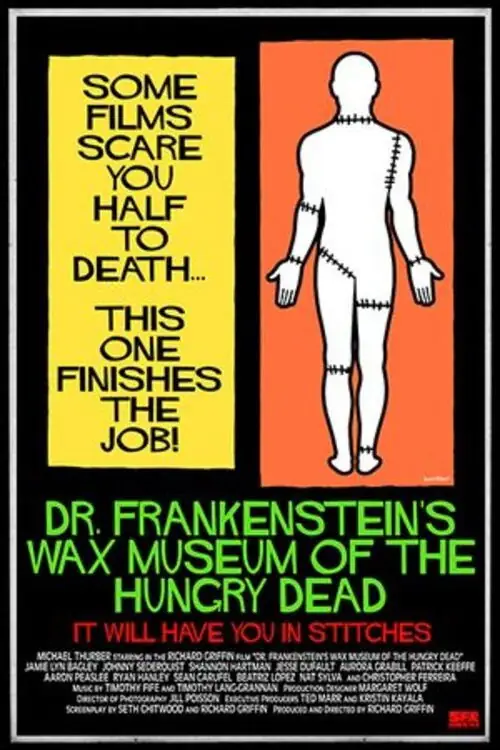
Dr. Frankenstein's Wax Museum of the Hungry Dead
REEL ENTRY · HORROR · LATE-NIGHT ENTRY
An academic excursion to a provincial exhibition of sculpted effigies transforms into a nightmarish ordeal when a cohort of secondary-school scholars discovers that the establishment serves as a laboratory for a deranged physician's obsession with constructing the ideal human specimen. The proprietor, a successor to the most notorious name in reanimative science, has been harvesting organic components from unsuspecting visitors in pursuit of his grand design—a composite organism assembled from the anatomical contributions of his predecessors in mortality. Each failed iteration lingers within the museum's labyrinthine corridors as a testament to the impossibility of his ambition, yet these botched amalgams possess sufficient vitality to constitute a genuine threat to any living person unfortunate enough to cross their path.
The scenario constructs a satisfying taxonomy of horror conventions while deploying them with sufficient self-awareness to avoid the trap of mechanical repetition. The waxworks themselves occupy an uncanny valley between simulation and sentience, their frozen expressions concealing capacities for violence that erupt with startling suddenness. The museum's architecture—a rambling confection of shadowed alcoves, concealed passages, and theatrical tableaux—functions as a malevolent organism in its own right, its spatial logic designed to disorient and entrap rather than accommodate. Every surface suggests the proximity of something dreadful, and the cinematography exploits this atmosphere of pervasive menace with considerable technical proficiency.
CUT TO · THE PAGE TURNS
The adolescent protagonists navigate this hostile environment with a combination of resourcefulness and panic that feels authentically calibrated—their terror is genuine rather than performative, and their survival strategies emerge organically from desperation rather than screenwriting convenience. The physician himself embodies a tradition of scientific hubris that stretches back to the Gothic origins of the genre, yet his particular mania—the conviction that perfection can be assembled from the salvaged fragments of imperfect beings—carries a resonant metaphorical charge regarding contemporary anxieties about biotechnological overreach. For aficionados of creature features that honor their literary antecedents while delivering the visceral satisfactions the genre promises, this excursion into manufactured monstrosity provides reliable entertainment with an undercurrent of genuine philosophical unease.
Source Reference
Original archive log: https://www.themoviedb.org/movie/331164?language=en-US